
Creative Side: 10 Best Ways to Keep Increasing Your Creativity in 2026

Your creative side is not a fixed trait you either have or do not have. Furthermore, creativity is a skill a muscle and like every muscle in your body, it grows stronger the more deliberately and consistently you train it. Moreover, some of the most creative people alive today were not born with extraordinary imagination. They built it, habit by habit, experience by experience, failure by failure. In this complete guide, you will discover exactly how to keep increasing your creative side in 2026 with real strategies, honest insights, and zero generic advice about “just thinking outside the box.”
What Your Creative Side Actually Is and Why It Matters
Before diving into strategies, it is worth understanding what your creative side actually means. Most people have a completely wrong picture of it. Furthermore, creativity is not exclusively about making art, writing poetry, or playing music.
In contrast, your creative side is the part of your brain that connects unrelated ideas. It finds unexpected solutions and sees possibilities where other people only see problems. Moreover, this kind of thinking is available to everyone not just artists.
In 2026, the ability to think creatively is one of the most valuable skills in virtually every field. Employers consistently rank creativity among the top three skills they look for in candidates. Additionally, as artificial intelligence handles more routine tasks, human creativity becomes the irreplaceable differentiator no algorithm can replicate.
Therefore, investing in your creative side is not just personally fulfilling. It is one of the smartest professional decisions you can make right now. Furthermore, the demand for creative thinkers is only growing stronger every single year.
Your creative side also directly impacts your mental health and overall well-being. Research published in the Journal of Positive Psychology found that people who engage in creative activities report higher levels of daily positive emotion and more energy.
Why Most People Feel Their Creative Side Is Shrinking
Here is something that happens to almost everyone you feel more creative as a child than as an adult. Moreover, this is not your imagination. It is a documented psychological phenomenon, and understanding why it happens is the first step to reversing it.
As children, we create without judgment. Furthermore, we draw without worrying whether the drawing is good, tell stories without caring whether they make sense, and build things without concerning ourselves with whether anyone else will appreciate them. In contrast, as we grow older, we internalize the evaluative gaze of teachers, peers, employers, and social media audiences. Additionally, we begin to self-censor before ideas even fully form dismissing them as stupid, unrealistic, or not good enough before they have a chance to breathe.
Moreover, modern life actively works against your creative side in ways that are easy to miss. The constant stimulation of social media, the pressure of productivity culture, the exhaustion of decision fatigue all of these consume the mental space that creativity needs to flourish. Furthermore, when your brain is perpetually busy consuming content, responding to notifications, and managing an endless task list, it never gets the idle downtime that creative thinking requires. Consequently, your creative side does not disappear it gets crowded out. And that means it can absolutely be reclaimed.
How to Start Rebuilding Your Creative Side From Scratch
Whether you feel like you have never been particularly creative or you used to be creative and lost it somewhere along the way, the rebuilding process starts in exactly the same place. Furthermore, it starts with removing the pressure to be good.
The single biggest barrier to accessing your creative side is the expectation that what you create has to be impressive, useful, or shareable. Moreover, this expectation is completely backwards. The entire point of creative practice especially in the beginning is to generate freely without evaluation. Additionally, the judgment and refinement come later. First, you have to give yourself unconditional permission to make things that are messy, weird, unfinished, and entirely for yourself.
In addition, starting small is not a compromise it is actually the most effective approach. Furthermore, research on habit formation consistently shows that tiny creative habits practiced daily build stronger neural pathways than large creative efforts made occasionally. Therefore, commit to five minutes of creative activity every single day rather than waiting for a free Saturday afternoon to sit down and make something extraordinary. Those five daily minutes compound into something remarkable over weeks and months in a way that sporadic creative bursts simply never do.
10 Proven Strategies to Keep Increasing Your Creative Side
Here are ten strategies that genuinely work not because a productivity guru said so, but because they are grounded in how your brain actually processes, generates, and develops creative thought.
Strategy 1: Consume Widely and Deliberately
Your creative side can only combine and remix what it has been exposed to. Furthermore, the more diverse your inputs books, music, films, conversations, experiences, disciplines the richer your creative output becomes. Moreover, this is not passive consumption. It is deliberate exposure to ideas outside your usual comfort zone. Additionally, reading a book in a field you know nothing about, watching a documentary on a subject you have never considered, or listening to music from a culture different from your own all load new raw material into your creative mind. Consequently, the connections your brain makes between these diverse inputs are the source of genuinely original ideas.
Strategy 2: Keep a Daily Idea Journal
One of the most powerful habits for strengthening your creative side is writing down every idea you have no matter how half-formed, impractical, or strange it seems. Furthermore, the act of capturing ideas trains your brain to generate more of them. Moreover, most people dismiss fleeting creative thoughts because they assume they will remember them later. They almost never do. Additionally, a physical notebook kept on your nightstand, your desk, or in your bag creates a low-friction system for capturing ideas the moment they arrive. Therefore, start an idea journal today and commit to filling at least one page every morning before you look at your phone.
Strategy 3: Embrace Boredom Intentionally
This one sounds counterintuitive, but it is backed by extensive neuroscience research. Moreover, your brain’s default mode network the neural system most associated with creative thinking activates most powerfully during periods of boredom and mind-wandering. Furthermore, the reason so many people have their best ideas in the shower, on a walk, or just before falling asleep is that these are the moments when their conscious mind relaxes and the default mode network takes over. Additionally, deliberately creating boredom sitting quietly without a phone, taking a walk without headphones, staring out a window without purpose gives your creative side the idle space it needs to make unexpected connections. Consequently, boredom is not the enemy of your creative side. It is the environment where your creative side does its deepest work.
Strategy 4: Collaborate With People Who Think Differently
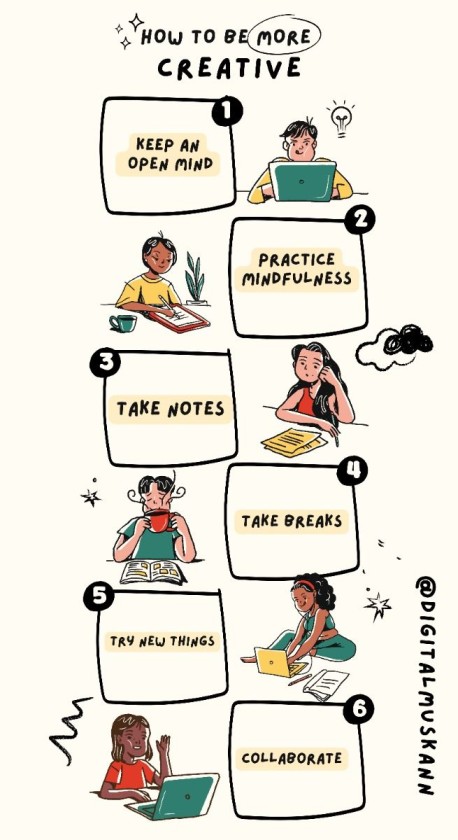
Your creative side expands dramatically when it encounters perspectives that challenge your existing assumptions. Furthermore, collaboration with people from different backgrounds, disciplines, and ways of thinking introduces friction and creative friction is extraordinarily productive. Moreover, when two people with genuinely different worldviews work on a problem together, the solutions they generate are almost always more creative than either person would have reached independently. Additionally, you do not need a formal creative partnership to experience this benefit. Simply having deep conversations with people whose lives look different from yours regularly introduces new mental models that enrich your creative thinking. Therefore, actively seek out relationships with people who see the world differently than you do.
Strategy 5: Impose Creative Constraints
Here is a strategy that surprises most people limiting your options actually increases creative output. Moreover, when you have unlimited possibilities, your brain experiences decision paralysis and defaults to familiar, safe choices. In contrast, when you impose constraints you can only use three colors, you have to write the entire piece in one sitting, you can only use found objects your brain is forced to find creative solutions within a defined boundary. Furthermore, some of the most celebrated creative works in history were produced under significant constraints. Additionally, constraints eliminate the blank page problem by giving your creative side a specific challenge to solve rather than an open-ended invitation to create anything. Consequently, the next time you feel creatively stuck, do not add more freedom add more constraints.
Strategy 6: Learn a Completely New Skill
Learning something entirely outside your area of expertise is one of the most powerful ways to expand your creative side. Furthermore, when you are a beginner, your brain is in a state of heightened neuroplasticity it is forming new connections, building new pathways, and seeing familiar things in unfamiliar ways. Moreover, the skills you develop in one domain transfer to others in ways you cannot predict in advance. Additionally, a writer who learns to paint starts to think about narrative in visual terms. A programmer who learns to cook starts to think about recipes as algorithms. Furthermore, these cross-domain transfers are where some of the most genuinely original creative thinking emerges. Therefore, pick one skill completely outside your expertise and spend 30 minutes a day learning it for the next three months.
Strategy 7: Protect Your Morning Creative Time
Your creative side is most accessible in the first one to two hours after waking, before the demands of the day have consumed your mental energy and filled your working memory with tasks, decisions, and social input. Furthermore, this is not just anecdotal neuroscience research confirms that the hypnopompic state between sleep and full wakefulness is characterized by looser associative thinking, reduced inhibition, and heightened access to subconscious material. Moreover, many of the world’s most prolific creators from Maya Angelou to Haruki Murakami to Charles Darwin structured their days around protecting morning hours for creative work exclusively. Additionally, even 30 minutes of creative practice before checking your phone or email produces measurably better creative output than the same 30 minutes taken later in the day. Consequently, guard your mornings fiercely and use them for your creative side first.
Strategy 8: Ship Imperfect Work Regularly
Perfectionism is the single greatest enemy of a growing creative side. Furthermore, the pursuit of a perfect output prevents you from completing things, sharing things, and learning from real-world feedback which are the three most important drivers of creative development. Moreover, every piece of creative work you finish and share teaches you something that no amount of internal refinement ever could. Additionally, the feedback you receive even criticism gives your creative side information it can use to grow. Furthermore, creators who publish regularly develop their skills exponentially faster than those who work in private waiting for everything to be perfect. Therefore, adopt a bias toward finishing and sharing, even when especially when the work does not feel ready.
Strategy 9: Study Creativity Itself
One of the most effective ways to develop your creative side is to study how creativity works in other people. Moreover, reading biographies and interviews with highly creative individuals reveals patterns and practices that you can directly apply to your own life. Furthermore, books like “Steal Like an Artist” by Austin Kleon, “Big Magic” by Elizabeth Gilbert, and “The War of Art” by Steven Pressfield offer genuine insight into the creative process that goes far beyond generic motivational advice. Additionally, watching documentaries about creative people at work musicians recording albums, architects designing buildings, writers wrestling with structure normalizes the messy, nonlinear reality of the creative process. Consequently, studying creativity demystifies it and makes your own creative struggles feel less like personal failure and more like a universal part of the process.
Strategy 10: Rest as a Creative Strategy
Finally, rest is not the opposite of creative work it is an essential part of it. Furthermore, sleep is when your brain consolidates new information, strengthens neural connections, and processes experiences into insights. Moreover, studies on creative problem-solving consistently show that people who sleep on a problem generate significantly more creative solutions than those who keep working through fatigue. Additionally, taking genuine breaks during creative work stepping away from the project entirely rather than just switching tasks allows your unconscious mind to continue processing in the background. Consequently, some of your best creative ideas will arrive not when you are sitting at your desk working hard but when you have stepped away and given your mind permission to wander. Therefore, treat rest as a non-negotiable part of your creative practice rather than a reward you earn after being productive enough.
The Benefits of a Growing Creative Side Nobody Talks About
Beyond the obvious joy of making things, a consistently developing creative side produces benefits that touch every area of your life. Furthermore, people with strong creative habits report significantly higher levels of resilience the ability to adapt and recover from setbacks because creative thinking naturally generates multiple solutions rather than fixating on a single path. Moreover, creativity builds emotional intelligence by requiring you to empathize with imagined perspectives, audiences, and characters. Additionally, the discipline of regular creative practice builds self-trust the deep knowledge that you can generate ideas, solve problems, and make something from nothing whenever you need to. Consequently, your creative side is not just a hobby or a talent. It is a fundamental life skill that makes you more capable, more resilient, and more fully yourself in every context you encounter.
Common Mistakes That Block Your Creative Side From Growing
Even with the best intentions, there are patterns that consistently prevent creative growth. Furthermore, comparing your creative output to that of experienced creators is one of the fastest ways to shut your creative side down entirely. Moreover, your chapter one will never look like someone else’s chapter ten, and measuring yourself against their finished work rather than your own starting point is a guaranteed path to discouragement. Additionally, waiting for inspiration before starting is a habit that keeps creative people permanently stuck because inspiration almost never arrives before the work begins. In contrast, it almost always arrives during the work. Furthermore, consuming more than you create creates a dangerous imbalance where your creative muscles atrophy from disuse while your critical faculties sharpened by constant consumption become increasingly harsh judges of your own output. Therefore, protect the ratio of creating to consuming and trust that your creative side grows fastest when it is actively used rather than passively admired in others.
Conclusion: Your Creative Side Is Waiting to Be Unleashed
Your creative side is not lost, broken, or absent. Furthermore, it is waiting beneath the noise, the self-doubt, the busy schedule, and the fear of judgment for you to give it consistent attention, genuine permission, and the daily practice it needs to grow. Moreover, every strategy in this guide is a proven path back to the creative thinking that has always been inside you. Additionally, the benefits of developing your creative side extend far beyond the work you make hey touch your confidence, your resilience, your relationships, and your sense of purpose in ways that compound over a lifetime. Furthermore, you do not need to be a professional artist, a published writer, or a celebrated musician to have a rich and growing creative life. In addition, you just need to show up every day, make something, learn from it, and show up again tomorrow. Consequently, start today not with a grand creative project but with five minutes and one honest idea. Your creative side will do the rest.